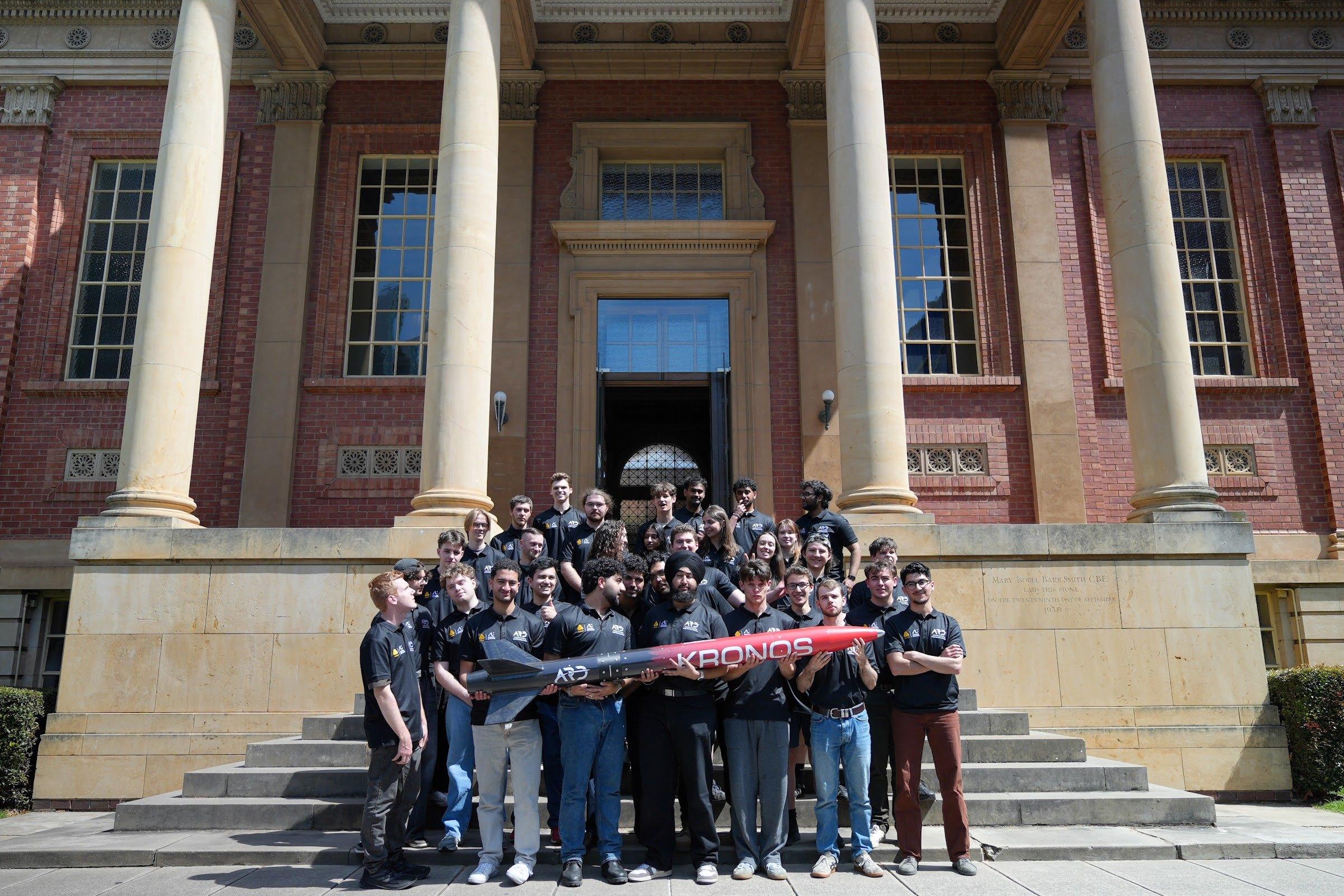
Three team members in black polo shirts hold the Kronos rocket horizontally in front of a sandstone and red-brick building; the rocket is black at the finned tail and fades to red towards the nose, with white "KRONOS" lettering.
Flown2026

Project Kronos

Kronos

2nd at AURC 2026 in 10,000 ft COTS, with SRAD avionics and active airbrakes.

2nd

AURC 2026
10,000 ft · COTS propulsion

Stages
Single-stage
Propulsion
Solid
Motor
AeroTech M1845NT-PS
Length
2.4 m
Diameter
156 mm
Apogee
10,000 ft target

Project Kronos is ARD's 2026 rocket for the 10,000 ft Commercial Off-The-Shelf (COTS) propulsion category of the Australian Universities Rocket Competition (AURC), flown as AURC26 Team #7 representing Adelaide University. A derivative of Project Myriad, it pairs the AeroTech M1845NT-PS motor with a 3 mm fibreglass airframe and a boat tail, SRAD avionics, active airbrakes and a 2U CubeSat payload. It placed 2nd.

360° render · Kronos

01Anatomy

Take it apart

Scroll to separate the rocket into its components. Each one is explained as it comes into view.

C-01·Nose cone

Nose cone

A Von Karman nose cone in 3 mm fibreglass with a CNC-lathed aluminium tip, made in one piece with the upper body section.

Shape
Von Karman (Haack series)
Material
3 mm fibreglass
Tip
CNC-lathed 6061 aluminium
Length
350 mm
The red nose section of Kronos lies in green and orange scrub with a parachute visible behind it.

C-02·Payload bay

Payload bay

A 2U CubeSat in the integrated nosecone body section measures how soil retains water under the g-loads of flight.

Format
2U CubeSat, CNC aluminium
Experiment
Soil water retention under g-load
Sensors
Two capacitive moisture sensors
Logging
Arduino Nano with SD card
Power
10,000 mAh battery
Mass
At least 2 kg

Built on

Technology · Payloads lineage

C-03·Recovery system (parachutes)

Recovery system

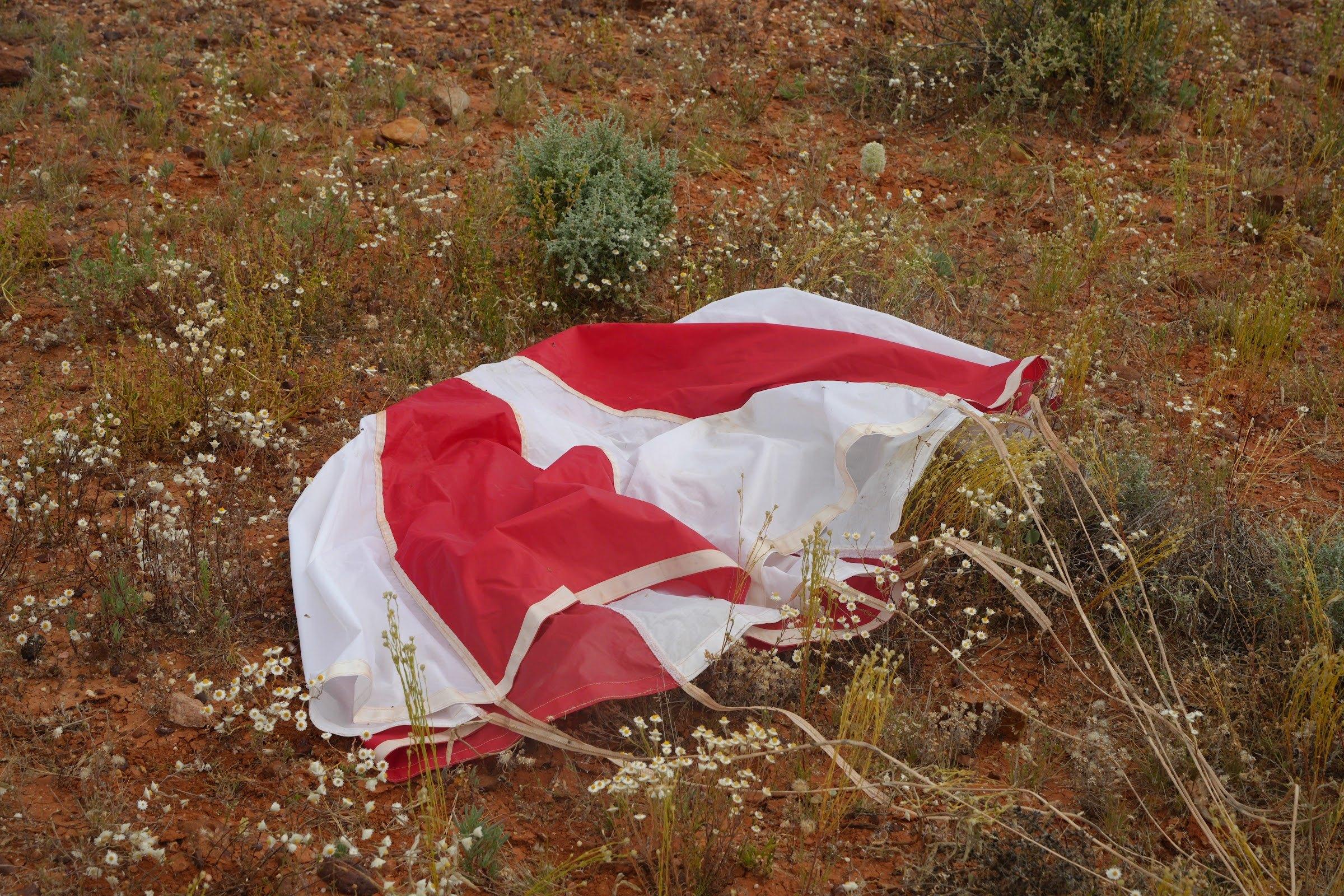
Single separation, dual deployment: the drogue opens at apogee, then a tether release frees the main parachute lower down.

Deployment
Single separation, dual deployment
Drogue
60 cm, at apogee
Main
200 cm, released at 1,225 ft by a TD2 tether
Ejection
CO2 pyro-pneumatic primary (45 g canister), black powder backup

Built on

  • Project Myriad

    Myriad's parachutes sat in separate bays. Kronos moves them side by side for a single separation.

  • Project Lightning

    Lightning's pneumatic deployment device was dropped before flight. Kronos makes CO2 pyro-pneumatic ejection the primary.

Technology · Recovery lineage

Close-up of a red and white parachute canopy lying on red soil among small white wildflowers.

C-04·Avionics bay

Avionics bay

ARD's three-board SRAD stack on a CAN bus, flown alongside a COTS Blue Raven flight computer and a Featherweight GPS tracker.

Boards
Flight computer, telemetry, power distribution
Flight computer
STM32F4, LSM6DSO IMU, DPS368 barometer, H3LIS100DL high-g accelerometer
Telemetry
LoRa 915 MHz, u-blox MAX-M10S GNSS
Power
3S 18650 (11.1 V); 3.3, 5 and 7.4 V rails
COTS
Blue Raven flight computer, Featherweight GPS tracker
Arming
Four pull-pin switches

Built on

  • Project Lightning

    Consolidates Lightning's four-board STM32 CAN stack into three boards.

  • Project Myriad

    Re-uses the familiar COTS flight computer and GPS from AURC 2025: the Blue Raven and the Featherweight GPS.

Technology · Avionics lineage

C-05·Airbrakes

Airbrakes

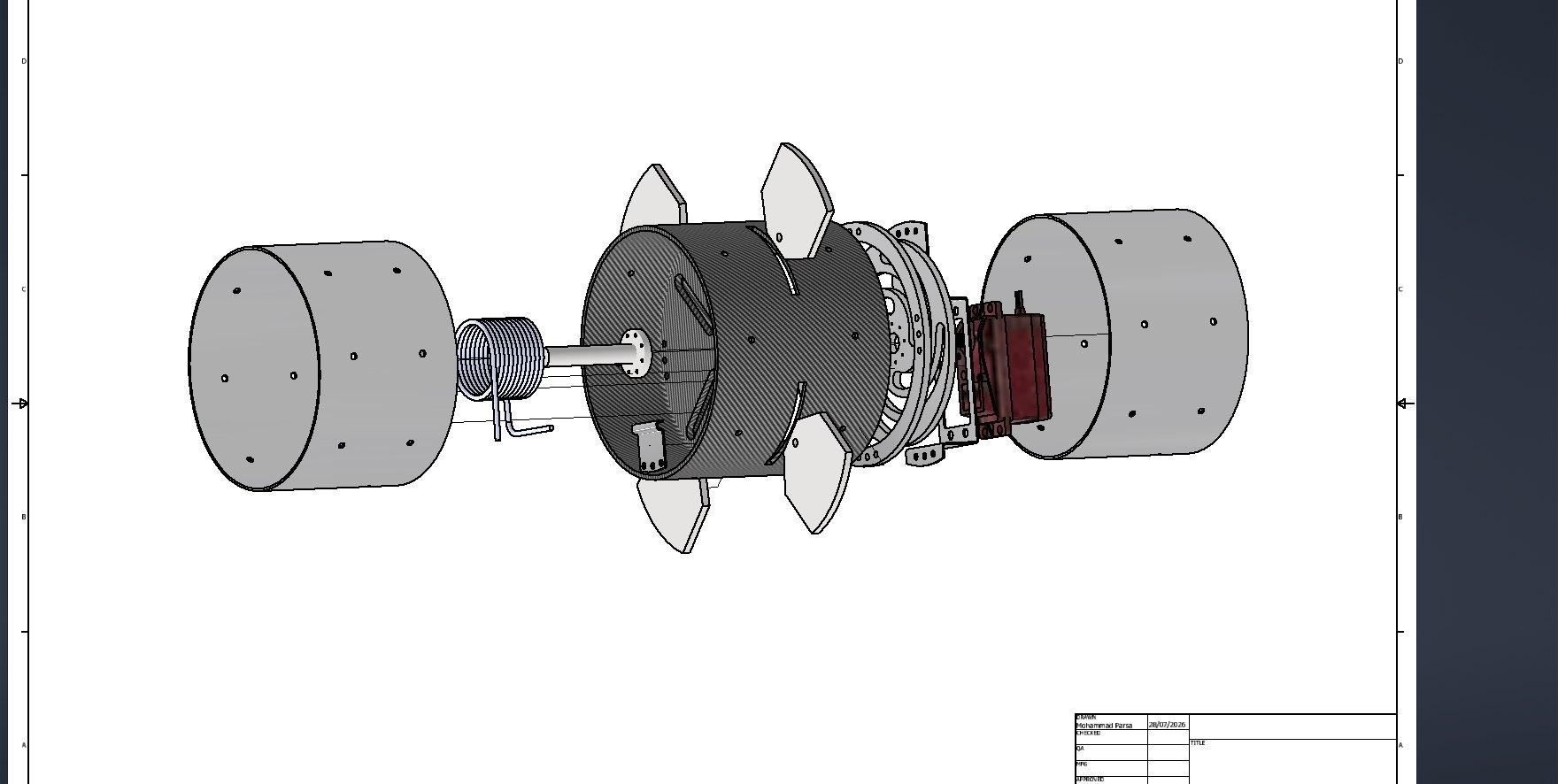
Four curved tabs deploy radially to trim the predicted overshoot down to the 10,000 ft target.

Tabs
Four curved radial tabs, 5 mm 6061 aluminium
Deployment
Up to 30 mm per tab
Drive
Single 60 kg servo turning a central disc
Fail-safe
Passive torsion spring opposing the servo
Estimation
Kalman filter
Drag model
CFD lookup table

Built on

  • Project Myriad

    Myriad's linear four-tab system was ARD's first attempt at active apogee control.

  • Project Lightning

    Lightning's rotary tabs in two stacked housings.

Technology · Airbrakes lineage

Exploded CAD view of the airbrake module: a central housing with four curved deployable tabs between two cylindrical end sections, with a lead screw and a red motor.

C-06·Motor and propulsion

Motor section

The aft airframe carries the 98 mm AeroTech M1845NT-PS in a LOC Precision Blue Tube mount, with 6 mm aluminium centering rings and thrust plate.

Motor
AeroTech M1845NT-PS (98 mm, M class)
Total impulse
8,307 N·s
Average thrust
1,875 N
Peak thrust
3,081 N
Burn time
4.4 s
Propellant
3,772 g
Motor mount
LOC Precision Blue Tube

Built on

  • Project Myriad

    The same M1845NT motor, flown on the 98 mm hardware from AURC 2025.

C-07·Fin can

Fin can

Four swept-back trapezoidal fins with a Nomex honeycomb core, an MDF edge frame and tip-to-tip carbon fibre.

Count
4
Planform
Swept-back trapezoid
Core
Nomex honeycomb, MDF edge frame
Reinforcement
Tip-to-tip carbon fibre

Built on

  • Project Myriad

    Replaces Myriad's trapezoidal carbon-reinforced plywood fins with a swept, honeycomb-core design.

The black aft section of Kronos with swept black fins lies on red soil among white wildflowers, next to a pair of work boots.

C-08·Boat tail

Boat tail

A conical boat tail reduces base drag from the low-pressure region behind the rocket.

Shape
Conical
Material
Vacuum-bagged fibreglass, split mould
Length
138 mm
Aft diameter
105 mm

02Lineage

What it built on

Every ARD rocket carries hardware, code and hard-won lessons from the ones before it.
  1. From

    Project Myriad

    Carried over

    The same AeroTech M1845NT motor on the 98 mm hardware from AURC 2025, the same internal diameter and overall material choices, and the COTS Blue Raven flight computer and Featherweight GPS.

    Lessons applied

    Wall thickness cut from 5 mm to 3 mm; swept fins with a Nomex honeycomb core; a boat tail; vacuum bagging; and the parachutes moved side by side for a single separation, with the avionics bay and airbrakes moved aft. Myriad landed under its target, so Kronos is simulated to about 11,000 ft and trimmed down by its airbrakes.

  2. From

    Project Lightning

    Carried over

    The multi-board STM32 avionics on a CAN bus, and the rotary airbrake work.

    Lessons applied

    Lightning dropped its pneumatic deployment device. Kronos brings pneumatic ejection back as the primary, with a CO2 pyro-pneumatic device and black powder as backup.

03Systems

Propulsion and ground

Stage 1 · Motor

AeroTech M1845NT-PS

Propellant
Solid
Impulse class
M

98 mm reloadable motor system, on the hardware from AURC 2025. Total impulse 8,307 N·s, average thrust 1,875 N, peak thrust 3,081 N, burn time 4.4 s.

Ground system

Ground station

A fully SRAD tracking station: LoRa telemetry at 915 MHz, a Yagi antenna on a pan/tilt mount, and landing-zone prediction.

Telemetry
LoRa 915 MHz
Antenna
Yagi on a pan/tilt mount
Pointing
Two Nema 17 stepper motors
Enclosure
Pelican case
Software
Landing-zone prediction

Technology · Ground station lineage

04Flight log

Launches

DateSiteOutcomeApogee
—White Cliffs, NSW2nd in 10,000 ft COTS—

05Results

On the board

  1. 2nd

    AURC 2026

    2nd place, 10,000 ft COTS

    10,000 ft · COTS propulsion · Kronos

    Source ↗ (opens in a new tab)
The Kronos rocket standing upright on its fins at the foot of a stone staircase between two columns; red nose cone, red-to-black fade along the body, vertical white KRONOS lettering and an ARD logo near the black finned tail.
Kronos, full length.
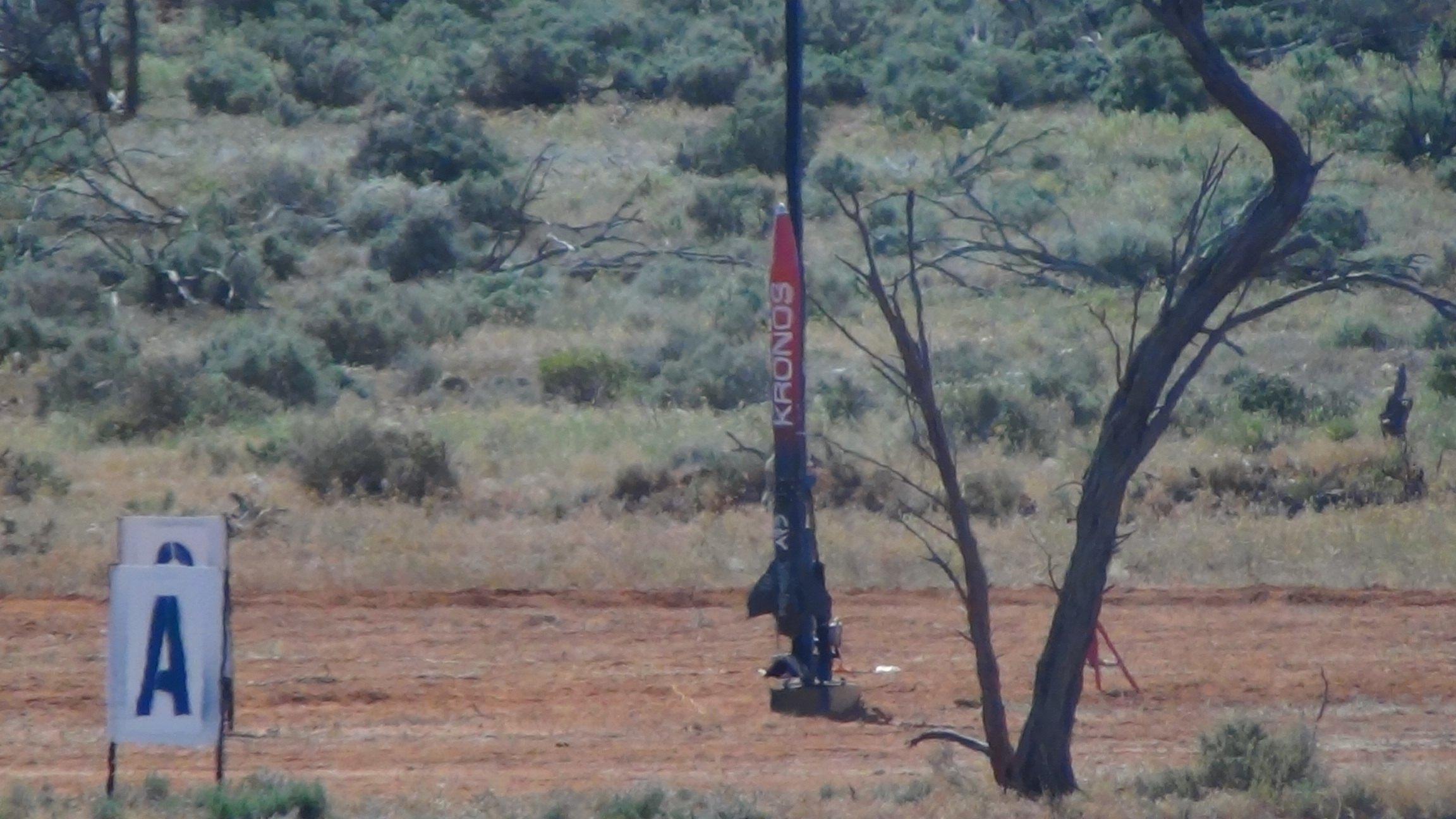
Kronos stands vertically on the launch rail beside a small tree in scrubland, with a pad marker sign reading "A" in the foreground.
On the rail, AURC 2026.
Two team members carry the assembled Kronos rocket horizontally across red dirt under a blue sky with scattered clouds.
AURC 2026.
Kronos lies on a folding table on red desert ground while team members and officials in hi-vis gather around it.
Pre-flight check, AURC 2026.
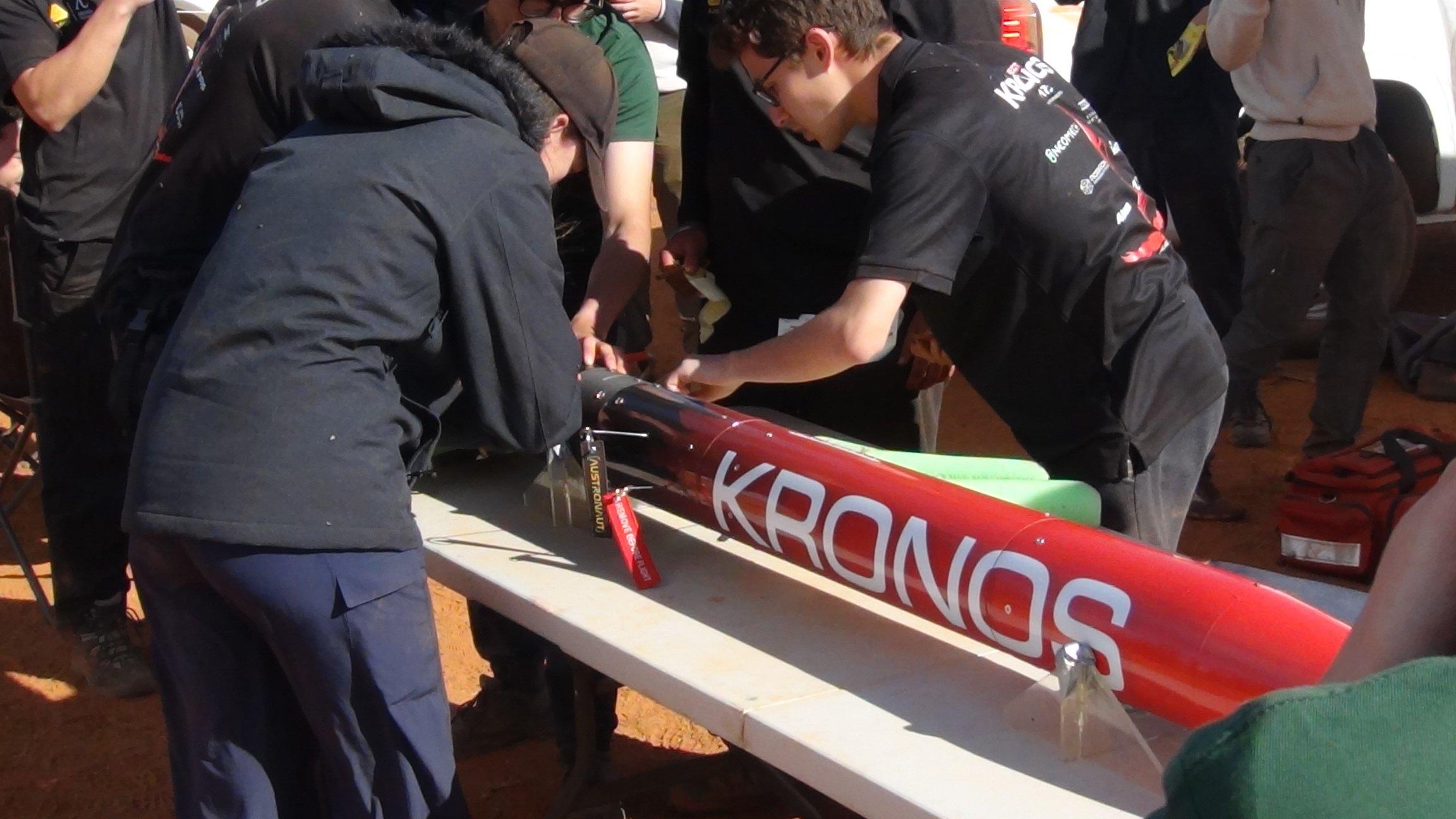
Under a shade tent, team members lean over a long table to assemble the red Kronos rocket, its white KRONOS lettering visible along the body.
Final assembly at AURC 2026.
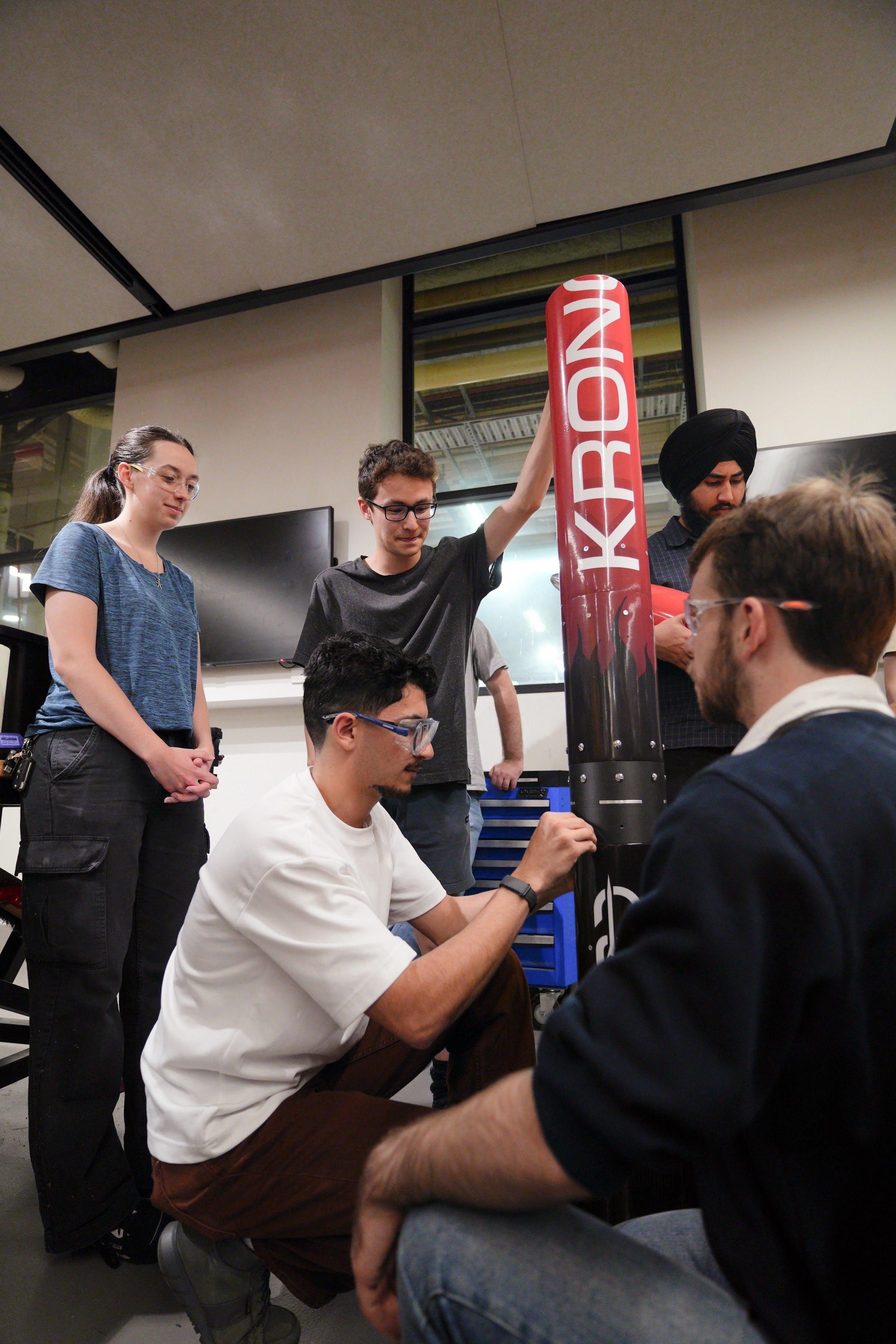
In a workshop, team members gather around the upright Kronos rocket while two of them kneel to work on its lower body section.
Working on Kronos in the workshop.
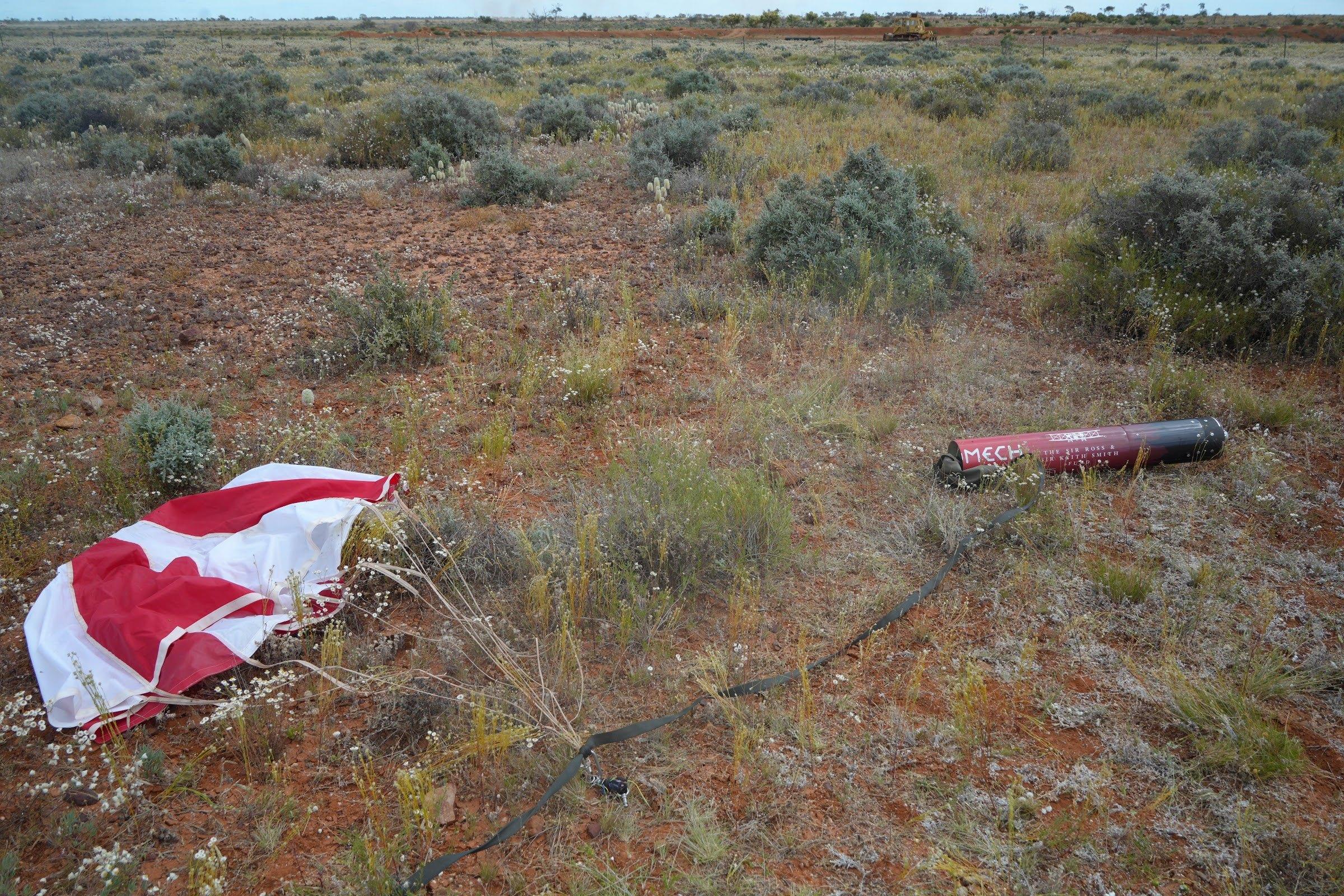
A red and white parachute lies spread over low scrub, with a red rocket body section on the ground further back.
Recovered after flight, AURC 2026.
The red nose section of Kronos lies in green and orange scrub with a parachute visible behind it.
Nose section after landing, AURC 2026.
The black aft section of Kronos with swept black fins lies on red soil among white wildflowers, next to a pair of work boots.
Fin can after landing, AURC 2026.
A large group of team members in black ARD shirts stands on the steps of a sandstone and red-brick building, with the front row holding the Kronos rocket horizontally.
The Adept Rocketry Division team with Kronos, 2026.

Build the next one.