Airbrakes
Active apogee control: tabs that deploy in flight to trim a rocket's climb to its target altitude.
01Overview
What it does
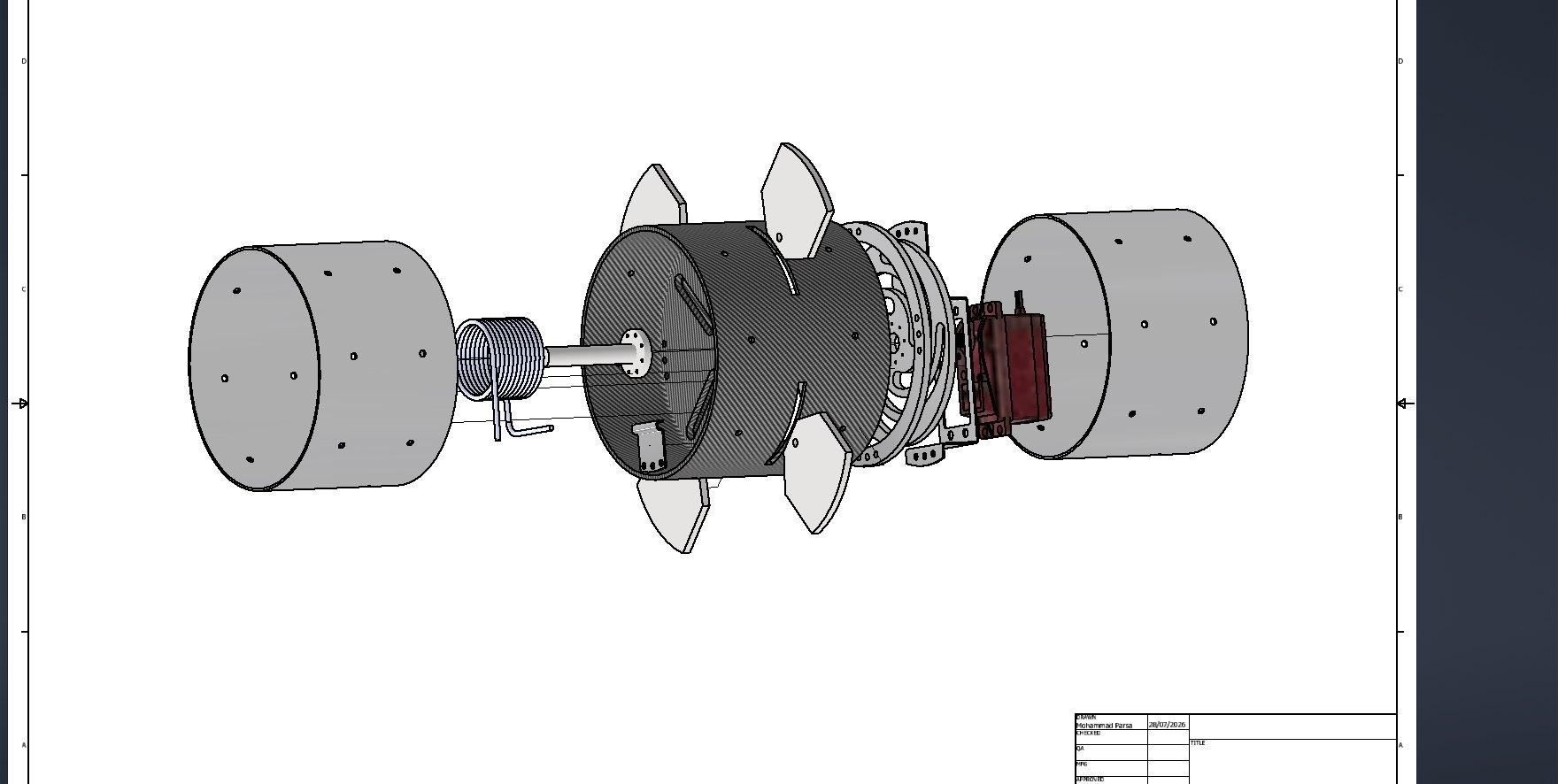
Kronos is simulated to about 11,000 ft and uses airbrakes to trim its apogee to the 10,000 ft target. Four curved aluminium tabs deploy radially from a central disc turned by a single servo, with a passive torsion spring opposing the servo as a fail-safe.
A Kalman filter estimates the rocket's state in flight, and a drag lookup table from CFD tells the controller how much drag each deployment gives: at 300 m/s and 2 km, from 542 N with the tabs closed to 730 N at 20 mm. The tabs and drive disc are waterjet-cut 6061 aluminium.
02Lineage
How it evolved
2020
First proposed
Airbrakes were floated as a future idea in the Trident Mk.2 progress report.
Flown onTrident Mk.2
2025
Linear four-tab system
ARD's first attempt at active apogee control: four tabs extended up to 25 mm by a high-torque servo under PID control. Prototypes moved from laser-cut acrylic to waterjet-cut aluminium.
Flown onProject Myriad
2025
Rotary tabs in two housings
Two stacked housings with two tabs each, at a 90° offset: four 6061-T6 aluminium tabs driven by a 35 kg·cm servo and a CFD drag lookup table.
Flown onProject Lightning
2026
Curved radial tabs
Four curved tabs deploy radially from a central disc turned by a 60 kg servo, up to 30 mm each, with a torsion-spring fail-safe and a Kalman filter.
Flown onProject Kronos
Build what comes next.