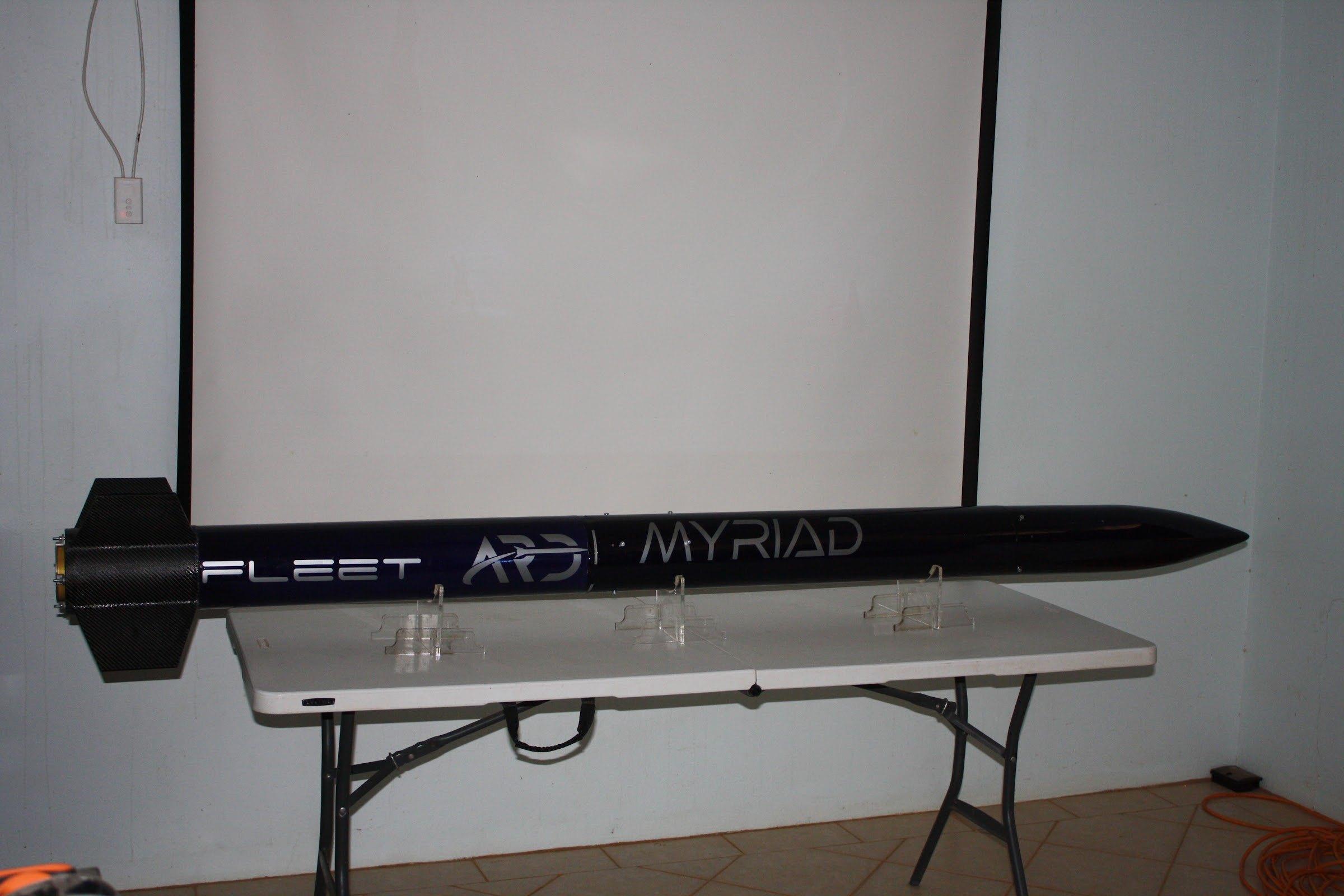
Side view of the Myriad rocket resting on clear stands on a white table: a dark navy body with "FLEET", an ARD logo and "MYRIAD" in white, a black ogive nose cone and a black finned tail.
Flown2025

Project Myriad

Myriad

4th at AURC 2025 in 10,000 ft COTS, with ARD's first airbrakes.

4th

AURC 2025
10,000 ft · COTS propulsion

Stages
Single-stage
Propulsion
Solid
Motor
AeroTech M1845NT-PS
Length
2.36 m
Diameter
160 mm
Apogee
8,900 ft

Project Myriad was ARD's Level 3 rocket for the 10,000 ft COTS category at the Australian Universities Rocket Competition (AURC) 2025: a 160 mm, three-section fibreglass rocket on the AeroTech M1845NT-PS. It introduced ARD's first active apogee control and carried a 1U CubeSat microfluidics experiment. It reached 8,900 ft above ground level and placed 4th.

01Anatomy

Take it apart

Scroll to separate the rocket into its components. Each one is explained as it comes into view.

C-01·Nose cone

Nose cone

A fibreglass Haack-series nose cone with a fineness ratio of 4.4.

Shape
Von Karman (Haack series)
Material
Fibreglass
Length
400 mm
Fineness ratio
4.4

C-02·Payload bay

Payload bay

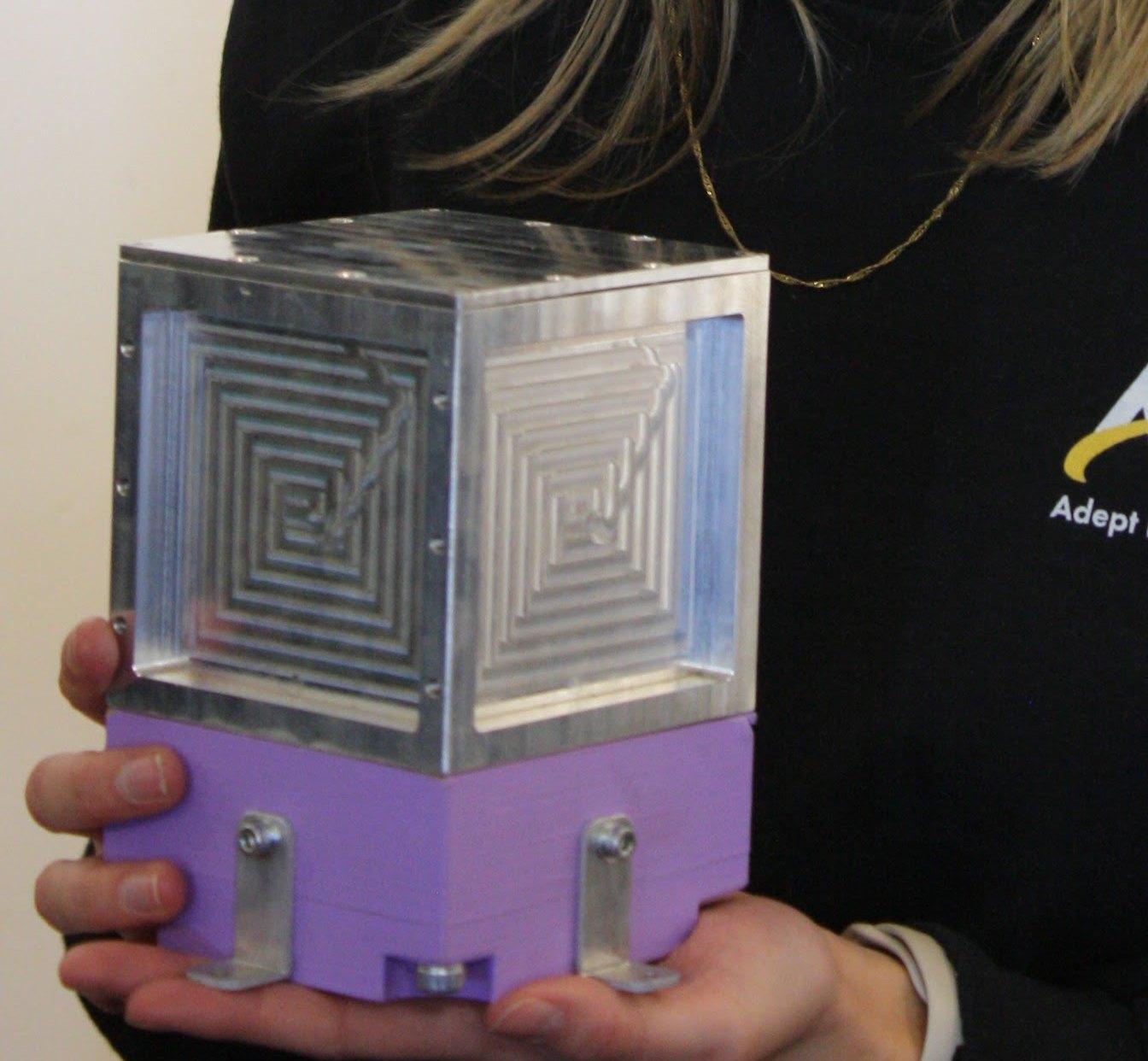
A 1U CubeSat (10 × 10 × 10 cm) biological experiment on microfluidics in microgravity, developed as a University of Adelaide honours project.
Format
1U CubeSat, 6061 aluminium
Experiment
Microfluidics in microgravity
Computer
Raspberry Pi Zero 2 W
Power
0.5U power unit

Technology · Payloads lineage

A machined aluminium cube with stepped square patterns on its faces, mounted on a purple 3D-printed base with metal brackets, held in two hands.

C-03·Recovery system (parachutes)

Recovery system

Dual deployment: a drogue at apogee, then the main parachute at 400 m above ground.

Deployment
Dual deploy
Drogue
68 cm, at apogee
Main
200 cm, at 400 m AGL
Ejection
Black powder, 0.26–0.5 g
Shear pins
4 main, 3 drogue
Protection
Nomex fire blankets

Technology · Recovery lineage

C-04·Avionics bay

Avionics bay

An SRAD flight computer built on an STM32F4, flown with a COTS backup altimeter.

Processor
STM32F4
IMUs
ICM-20948, LSM6DS3TR
Barometer
BMP388
GNSS
u-blox NEO-M8
Telemetry
RFM95CW LoRa
Power
4 × 18650 cells

Built on

Technology · Avionics lineage

C-05·Airbrakes

Airbrakes

ARD's first attempt at active apogee control: four tabs extended by a high-torque servo under PID control.

Tabs
4
Extension
Variable, 0–25 mm
Drive
High-torque servo
Control
PID
Construction
Prototyped in laser-cut acrylic, then waterjet-cut aluminium

Technology · Airbrakes lineage

C-06·Recovery system (parachutes)

Main parachute bay

Carries the 200 cm main parachute, deployed at 400 m above ground.

Technology · Recovery lineage

C-07·Motor and propulsion

Motor section

The 900 mm aft airframe carries the 98 mm AeroTech M1845NT-PS reloadable motor.

Motor
AeroTech M1845NT-PS (98 mm, M class)
Total impulse
8,307 N·s
Average thrust
1,875 N
Maximum thrust
3,081 N
Burn time
4.4 s
Thrust-to-weight
9.25 at lift-off

Built on

C-08·Fin can

Fin can

Four trapezoidal plywood fins, reinforced tip-to-tip with carbon fibre.

Count
4
Planform
Trapezoidal
Construction
Plywood, tip-to-tip carbon fibre
Thickness
5.5 mm

02Lineage

What it built on

Every ARD rocket carries hardware, code and hard-won lessons from the ones before it.
  1. From

    Project Myriad (2024)

    Carried over

    The 160 mm, 2.36 m three-section airframe (280, 760 and 900 mm sections), the fibreglass construction and the AeroTech M1845NT-PS motor.

  2. From

    L2 Prototype

    Carried over

    The fibreglass airframe, nose cone, tip-to-tip fins and dual deployment first validated on the May 2024 L2 prototype.

03Systems

Propulsion and ground

Stage 1 · Motor

AeroTech M1845NT-PS

Propellant
Solid
Impulse class
M

98 mm reloadable motor. Total impulse 8,307 N·s, average thrust 1,875 N, maximum thrust 3,081 N, burn time 4.4 s.

04Flight log

Launches

DateSiteOutcomeApogee
—White Cliffs, NSW4th in 10,000 ft COTS8,900 ft

05Results

On the board

  1. 4th

    AURC 2025

    4th place, 10,000 ft COTS

    10,000 ft · COTS propulsion · Myriad

    Source ↗ (opens in a new tab)
A team member in a face shield stands beside the navy Myriad rocket mounted on a blue launch rail, with "MYRIAD" lettering running up the body.
Pad preparation, AURC 2025.
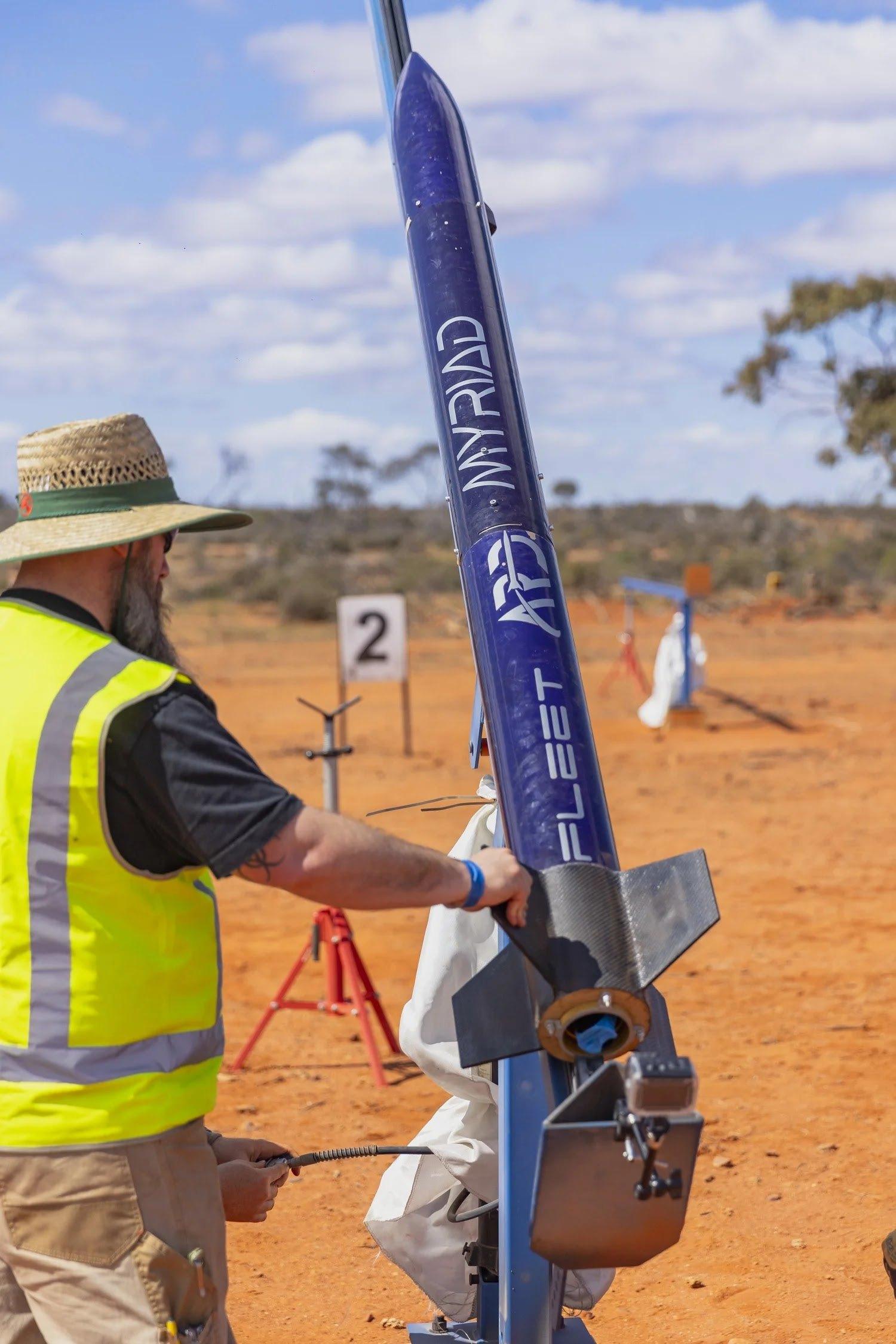
A range official in a hi-vis vest and wide-brimmed hat works at the base of the navy Myriad rocket on a blue launch rail.
AURC 2025.
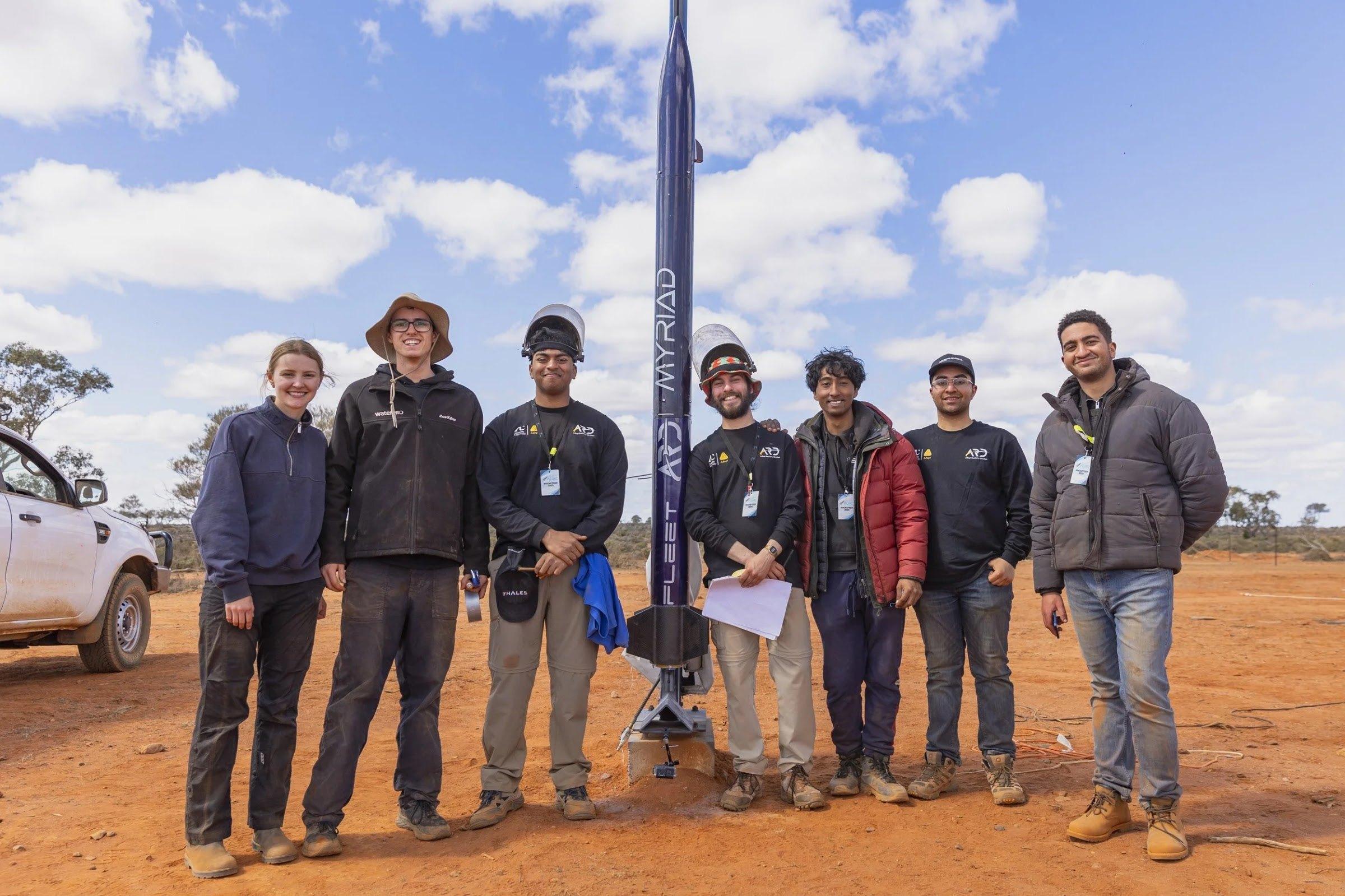
A line of team members stands on red dirt in front of the Myriad rocket mounted vertically on its launch rail.
At the pad, AURC 2025.
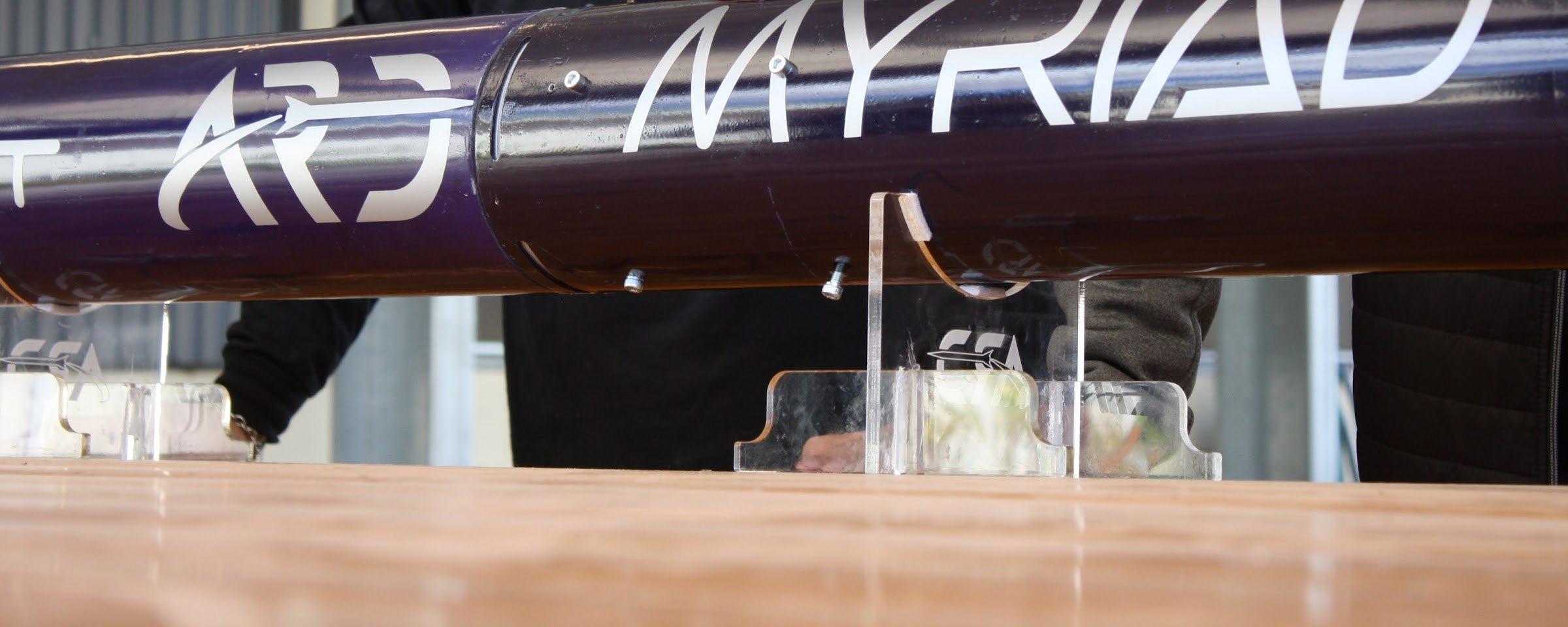
Close-up of Myriad's glossy navy airframe on clear acrylic stands, showing the white ARD logo and "MYRIAD" lettering across a body-tube joint.
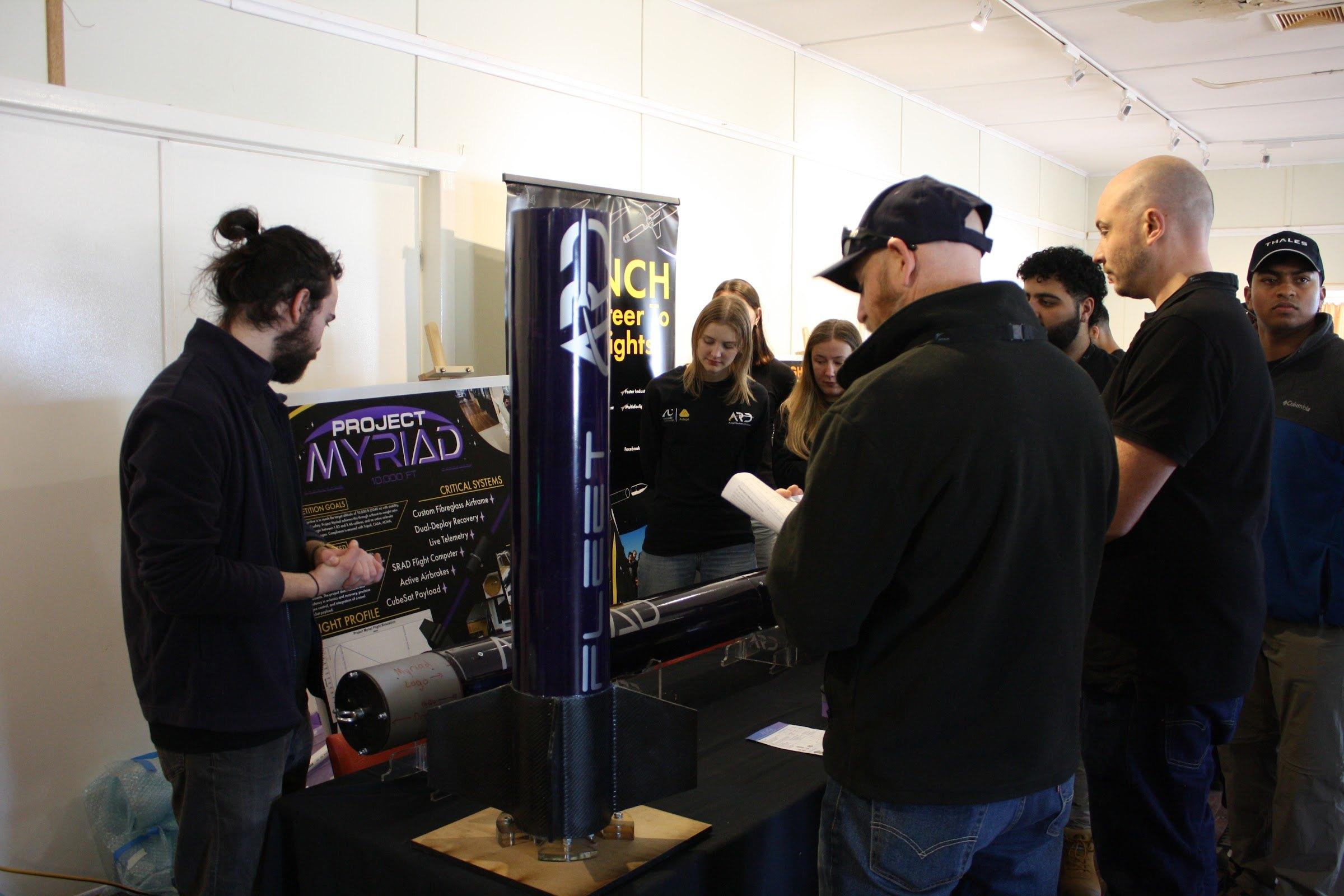
Myriad's upper section stands upright on a display table beside a "Project Myriad" poster while visitors talk with team members.
AURC 2025.
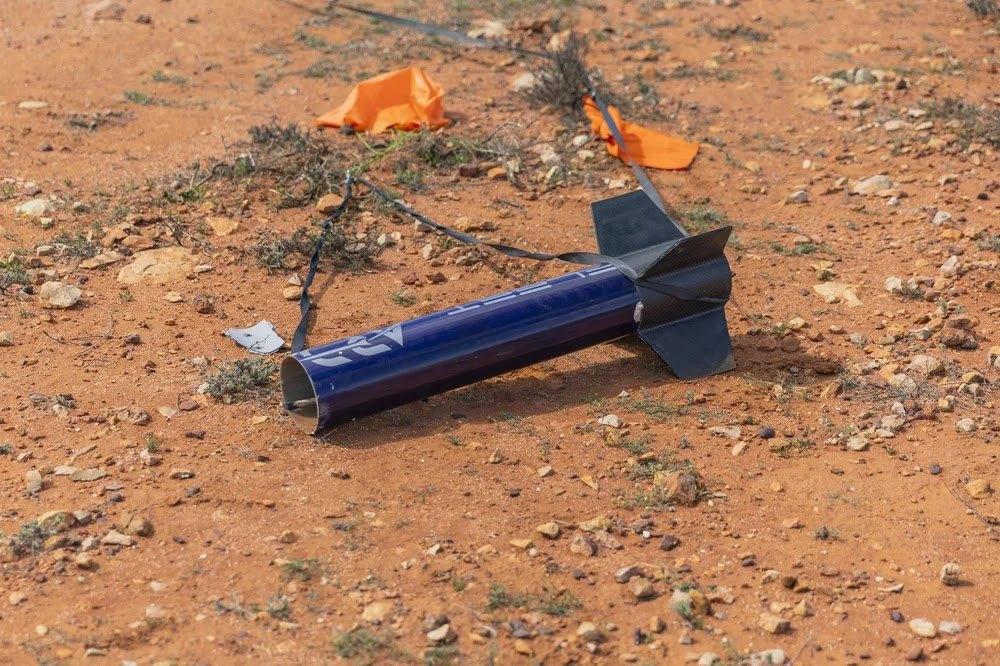
The navy aft section of Myriad with black fins lies on red soil after landing, with orange marker flags nearby.
After landing, AURC 2025.
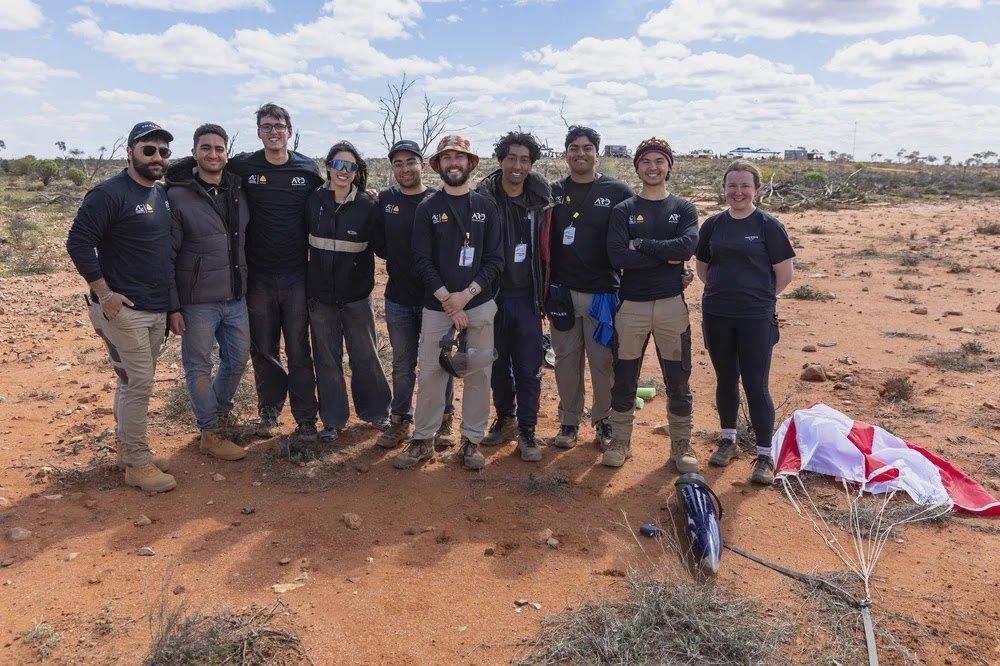
A group of team members stands behind the recovered Myriad rocket and its red and white parachute on red desert ground.
Recovery, AURC 2025.
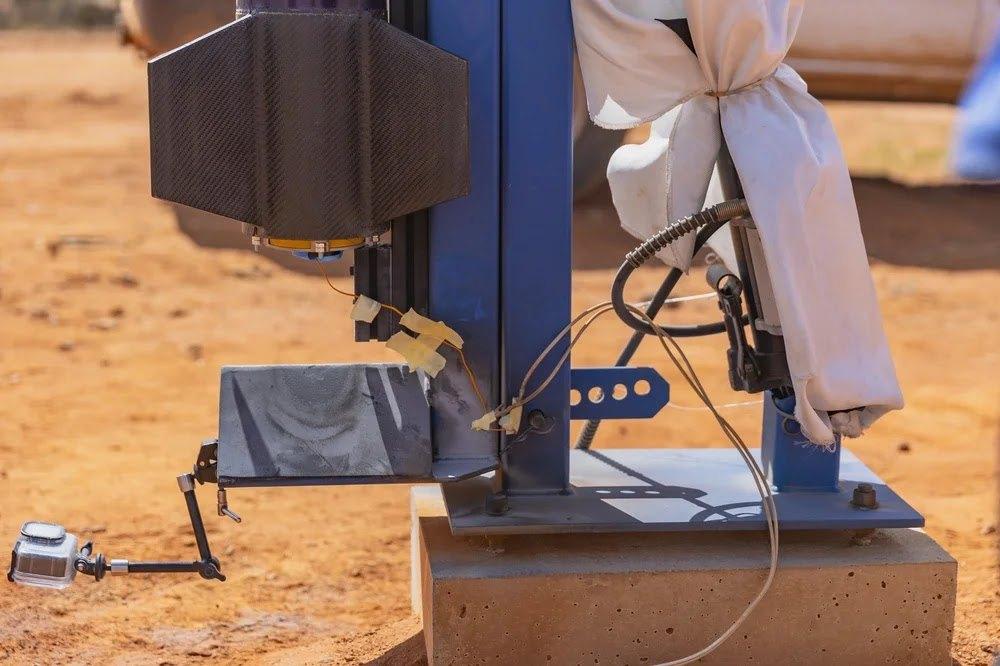
Close-up of the base of a blue launch rail with a steel blast deflector, ignition wiring and a white cloth-wrapped fitting on a concrete footing.
AURC 2025.

Build the next one.