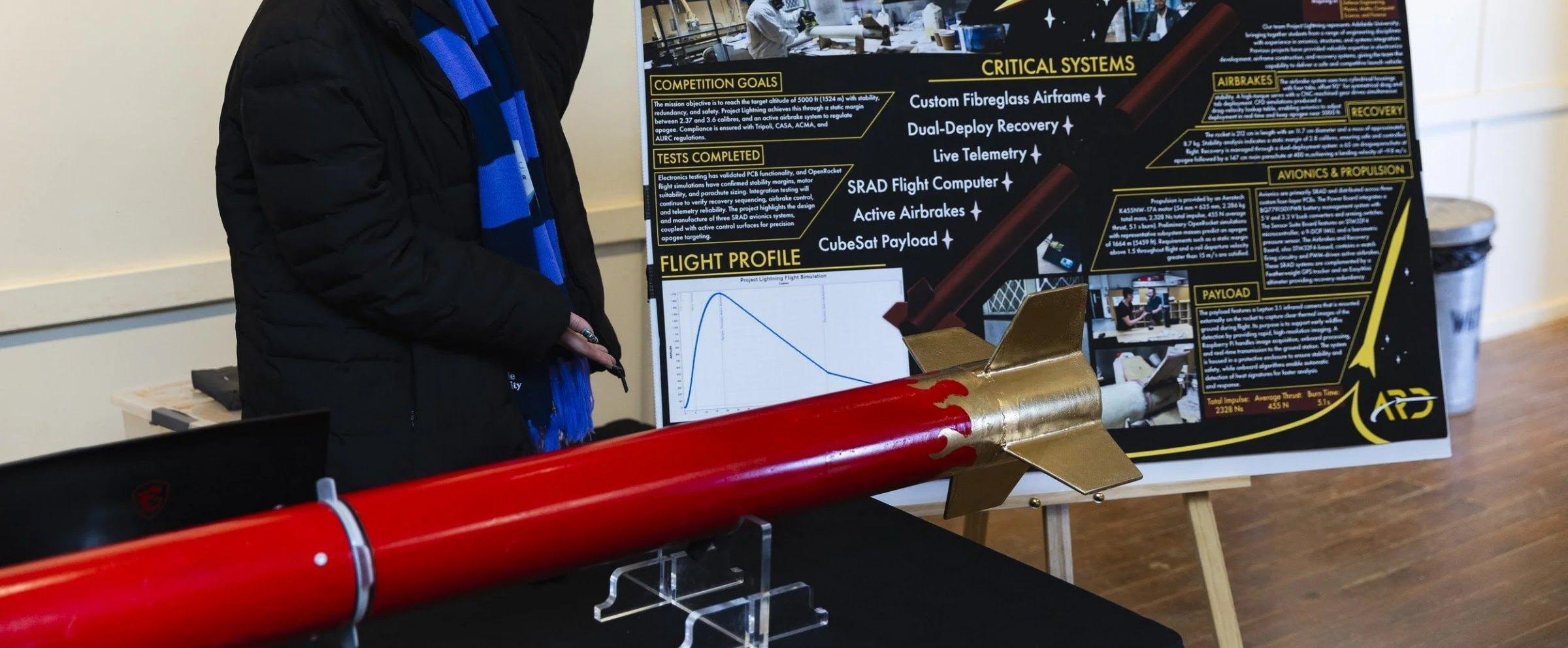
Project Lightning
Lightning
4th at AURC 2025 in 5,000 ft COTS, on an airframe made with ARD's own composite spinner.
4th
AURC 2025
5,000 ft · COTS propulsion
- Stages
- Single-stage
- Propulsion
- Solid
- Motor
- AeroTech K455NW-17A
- Length
- 2.08 m
- Diameter
- 117 mm
- Apogee
- 5,000 ft target
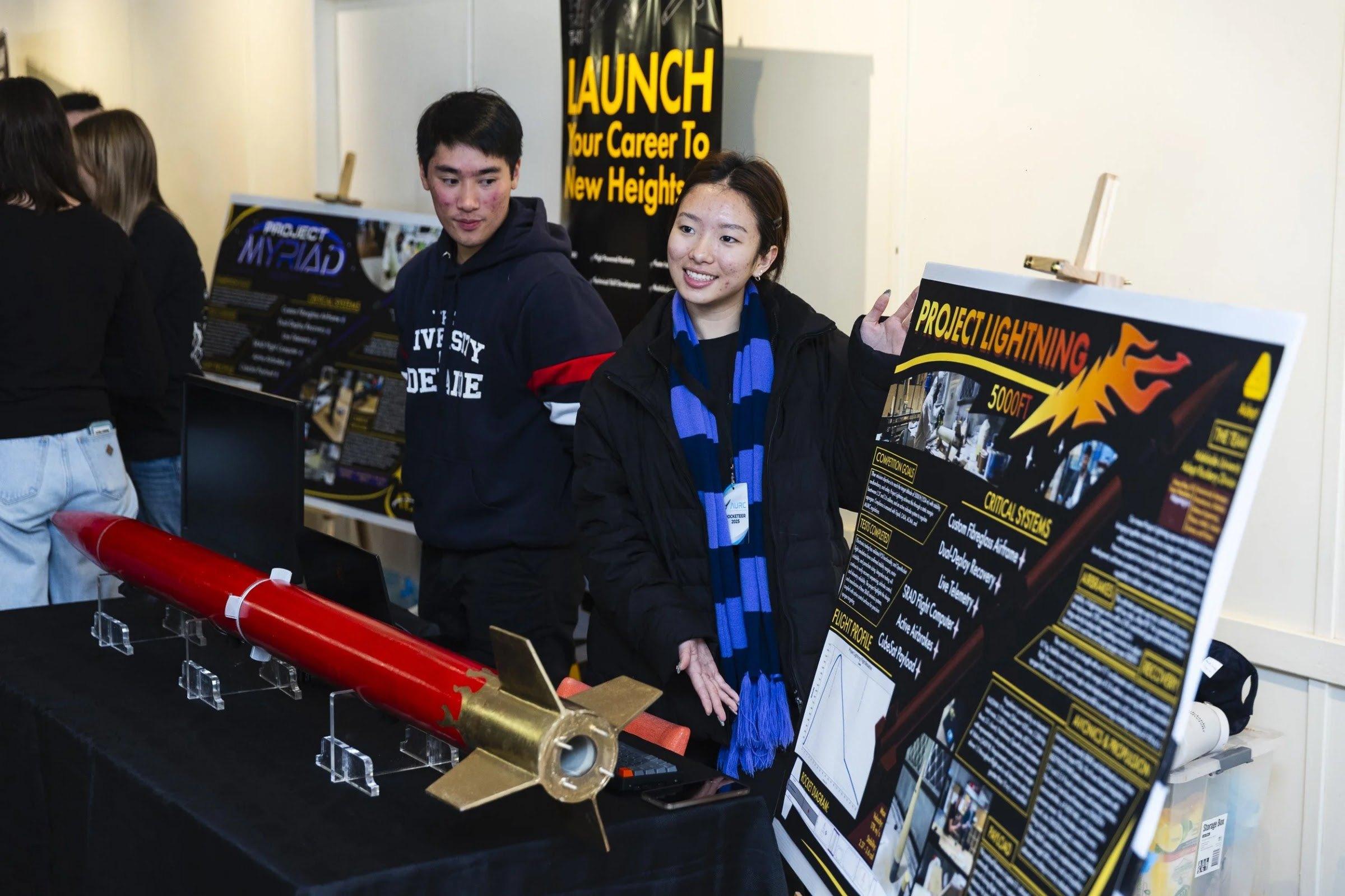
Project Lightning was ARD's Level 2 rocket for the 5,000 ft COTS category at the Australian Universities Rocket Competition (AURC) 2025. Its fibreglass airframe tubes were made on ARD's SRAD automated composite spinner, and it flew a four-board SRAD avionics stack, rotary airbrakes and a wildfire-detection thermal camera. It placed 4th.
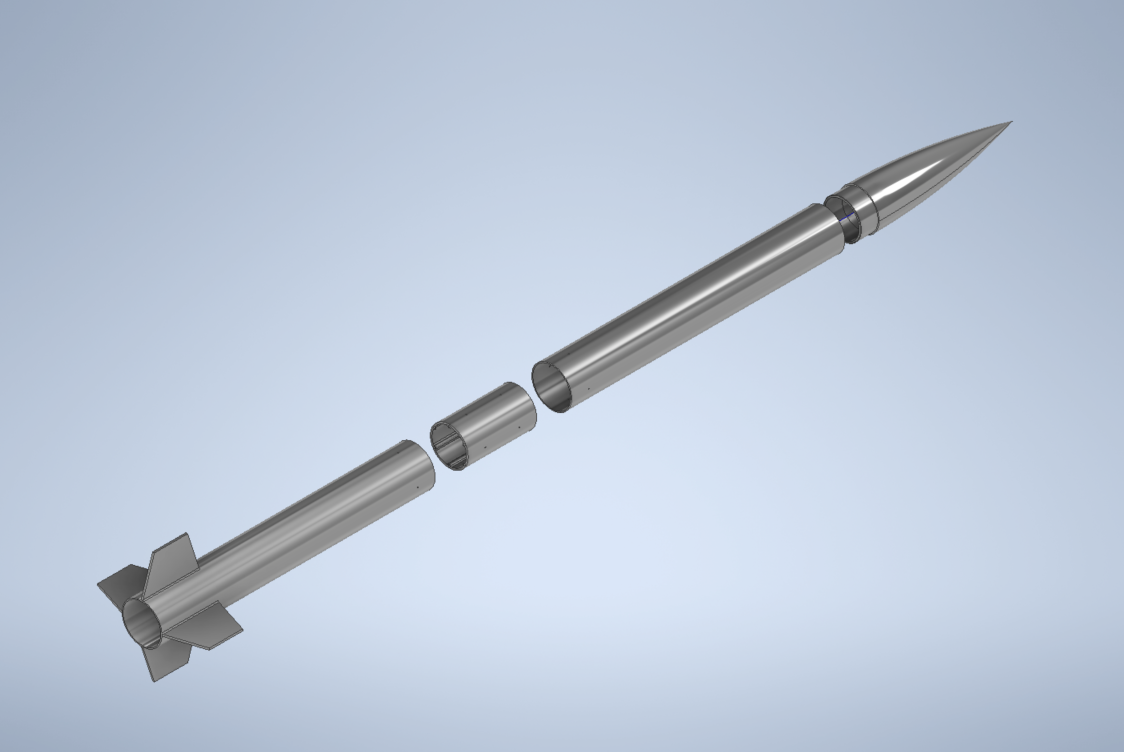
01Anatomy
Take it apart
C-01·Nose cone
Nose cone
A Haack-series Von Karman nose cone, laid up in fibreglass on a PLA male mould and vacuum bagged.
- Shape
- Von Karman (Haack series)
- Length
- 450 mm
- Fineness ratio
- 3.85
- Construction
- Fibreglass on a PLA male mould, vacuum bagged
C-02·Recovery system (parachutes)
Recovery system
Dual deployment on black powder charges. A pneumatic deployment device was planned, then dropped.
- Deployment
- Dual deploy, black powder
- Drogue
- 24" hexagonal printed nylon, at apogee
- Main
- 58" octagonal, at 500 m
- Shear pins
- 4 per section
C-03·Payload bay
Payload
A wildfire-detection payload: a FLIR Lepton 3.5 thermal camera on a PureThermal board, run by a Raspberry Pi 3.
- Mission
- Wildfire detection
- Camera
- FLIR Lepton 3.5 via PureThermal
- Computer
- Raspberry Pi 3
C-04·Avionics bay
Avionics bay
ARD's first multi-board SRAD avionics: a four-board PC/104-style stack on a CAN bus, with a COTS EasyMini.
- Boards
- Battery management, attitude determination, flight controller / mission control, telemetry
- Processor
- STM32F446RET6
- Sensors
- LSM6D / ICM-42688P IMU, H3LIS331DL high-g accelerometer, TE MS5611 barometer
- GNSS
- u-blox NEO-M8
- Radio
- CC1200
- Battery management
- BQ77915
- COTS
- EasyMini
Built on
- Project Myriad (2024)
Replaces the single-board SRAD flight computer of earlier years with a modular four-board stack.
C-05·Airbrakes
Airbrakes
Two stacked housings with two tabs each give four tabs at 90° offsets, driven by a servo and a CFD drag lookup table.
- Tabs
- Four, in two housings of two
- Material
- 6061-T6 aluminium
- Drive
- 35 kg·cm servo at 6 V
- Control
- CFD drag lookup table
- Mounting
- Top coupler, PETG 3D-printed with fibreglass
C-06·Recovery system (parachutes)
Main parachute bay
Carries the 58" main parachute, deployed at 500 m.
C-07·Motor and propulsion
Motor section
The 95 cm aft tube carries the 54 mm AeroTech K455NW-17A motor.
- Motor
- AeroTech K455NW-17A (54 mm, K class)
- Total impulse
- 2,328 N·s
- Average thrust
- 455 N
- Burn time
- 5.1 s
- Airframe
- In-house fibreglass, SRAD composite spinner
- Diameter
- 117 mm OD, 111 mm ID
C-08·Fin can
Fin can
Four trapezoidal fins with a plywood core and tip-to-tip fibreglass.
- Count
- 4
- Planform
- Trapezoidal
- Construction
- Plywood core, tip-to-tip fibreglass
- Thickness
- 5.5 mm
02Systems
Propulsion and ground
Stage 1 · Motor
AeroTech K455NW-17A
- Propellant
- Solid
- Impulse class
- K
54 mm motor, 635 mm long. Total impulse 2,328 N·s, average thrust 455 N, burn time 5.1 s, propellant 1.361 kg.
03Flight log
Launches
| Date | Site | Outcome | Apogee |
|---|---|---|---|
| — | White Cliffs, NSW | 4th in 5,000 ft COTS | — |
04Results
On the board
Build the next one.